



Articles
When your client becomes an agent
Wealth managers are using AI to remove work from internal processes. The next competitive shift begins when clients arrive with agents of their own.

Most AI programmes in wealth management still focus on employee productivity: retrieving research, drafting meeting notes, assembling know-your-customer evidence and preparing client communications. These use cases matter because they release adviser capacity and shorten manual queues.
They are also the first stage of a larger change. As agents gain permission to interpret information and act across systems, the client journey can move from human-led handoffs towards coordinated execution. The operating model changes again when an external agent acts for the client and interacts with the wealth manager’s systems or agents.
That final stage remains emerging. Wealth managers should prepare for it now because the commercial proposition, control framework and technology architecture take longer to redesign than the agent itself.
The market is moving through three distinct stages
The industry often groups every AI use case under the word ‘agentic’. That obscures the maturity and risk of what firms are actually deploying.
- Assistive AI. A person remains the operator and uses AI to retrieve, summarise or draft. Morgan Stanley’s Debrief tool, for example, creates meeting notes, surfaces actions, drafts a follow-up email for adviser review and stores a record in Salesforce. Morgan Stanley reported in 2024 that 98% of its financial-adviser teams had adopted its earlier AI Assistant.
- Internal agentic workflows. Agents initiate and coordinate tasks inside the firm’s control boundary. Bank of Singapore’s Source of Wealth Assistant extracts and structures information, identifies gaps and prompts follow-up within KYC workflows. OCBC reports that work taking up to ten days can be completed in about an hour, with relationship managers and compliance teams retaining judgement and final approval.
- External agent-to-agent interaction. An authorised client-side agent exchanges information or instructions with a firm’s agent or agent-enabled service. This is the A2A operating-model shift. Open protocols are beginning to support it, but scaled wealth-management adoption has yet to be demonstrated.
The distinction matters. The first two stages can improve the economics of existing journeys. The third can change how clients search, compare, challenge and switch between providers.
The client-side agent is becoming a credible market scenario
The strongest evidence comes from the regulator. The FCA’s 2026 Mills Review found that 20% of surveyed UK adults, equivalent to about 11 million people, would be likely to use AI capable of acting autonomously within preset goals. The review describes agents that could monitor savings, manage investment portfolios, pursue complaints and switch providers. It also recommends building the foundations for agentic finance.
The survey covers retail financial services broadly, so it should not be read as a forecast of adoption among wealth-management clients. It does establish a direction of travel: some consumers are willing to delegate financial tasks, and the regulator now treats the required infrastructure as a live policy question.
For wealth managers, the commercial implication is direct. A client-side agent could compare fees and service commitments, request evidence behind advice, monitor whether actions were completed and identify unexplained delays. Service quality becomes easier to measure. Switching friction could fall.
This makes the proposition machine-readable. Firms will need to express their value through structured fees, clear service standards, traceable advice rationale and reliable execution. The relationship manager remains central, particularly where judgement and trust matter. The digital service surrounding that relationship becomes much more visible.
A2A changes the operating model before it changes the interface
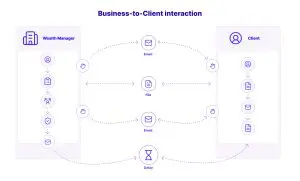
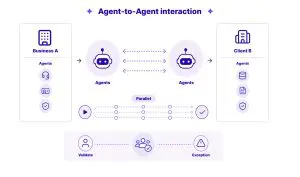
Sequential processes are common in wealth management because information and accountability pass through people. Onboarding waits for documents. KYC waits for review. Suitability waits for verified inputs. Compliance and reporting follow upstream decisions.
Agents can run some of those activities concurrently. They cannot remove every dependency. Identity must still be verified before certain decisions are made. Advice must still reflect complete and reliable information. Regulatory and evidential gates remain even when human queues shrink.
The operating model therefore needs to distinguish between tasks that can run in parallel, decisions that depend on verified inputs and actions that require accountable human judgement. A firm that simply accelerates every handoff may move weak information and poor decisions faster. A firm that redesigns the journey around the outcome can reduce elapsed time while protecting the control points that matter.
This is where the commercial and risk agendas meet. Faster onboarding reduces the period between client commitment and funded assets. Less manual intervention can improve cost to serve. Better evidence can reduce rework and support more consistent decisions. Those benefits only persist if exception rates, client harm and remediation costs remain controlled.
Interoperability does not create trust
Two standards are often conflated. Model Context Protocol (MCP) connects AI applications to tools and data. Agent2Agent (A2A) standardises how separate agents discover and communicate with each other. They solve different integration problems.
Both make connection easier. Neither tells a wealth manager whether an external agent is competent, authorised or safe to trust. Technical compatibility is only the transport layer.
A client agent may use incomplete data, rely on an unsupported inference or carry instructions that conflict with the client’s interests. It may also be compromised. NIST’s work on agent identity highlights the practical requirements: identification, authentication, authorisation, auditable action, non-repudiation and defences against prompt injection.
The quality question is therefore broader than model accuracy. Wealth managers need to know who authorised the agent, what it may do, which evidence supports its request and how responsibility will be resolved if the interaction causes harm.
Four decisions to make before external agents arrive
- Define identity and authority. Every external agent needs a verifiable identity tied to the person or organisation it represents. Its authority should be specific to the task, time-limited where appropriate and revocable. A general statement that an agent acts ‘for the client’ is insufficient.
- Set an evidence standard. Specify the information required for each decision, how provenance is recorded and when an internal agent must challenge or reject an input. Confidence scores and fluent explanations are not substitutes for evidence.
- Bound the action. Decide which activities an agent may complete, which need approval and which always require a person. Limits should cover value, data sensitivity, product risk, client vulnerability and the potential impact of error.
- Design failure and redress. Define what happens when agents disagree, a request cannot be explained, information proves false or an action causes harm. The model needs clear escalation, complaint, remediation and audit routes before it goes live.
These decisions sit within existing accountability. The FCA has said that the Consumer Duty, the Senior Managers and Certification Regime and its expectations for governance and controls will provide the framework for AI oversight.
An agent can perform work. It cannot absorb the firm’s regulatory responsibility.
What wealth-management leaders should do now
The immediate priority is preparation. A wholesale A2A build would be premature.
For firms with legacy technology, conservative risk appetites and relationship-led cultures, the harder task may be building confidence to redesign controls, client journeys and operating models around a future whose timing remains uncertain. The practical response is to make today’s propositions, processes and controls more legible, measurable and adaptable, so they are ready when adoption accelerates without committing to a wholesale external-agent build before demand is clear.
- Classify the current portfolio. Separate assistive AI, internal agentic workflows and external A2A concepts. Apply controls that match the real level of autonomy and exposure.
- Redesign one high-friction journey. Choose a process with measurable commercial leakage, such as onboarding. Map which activities can run concurrently, which inputs must be verified and where human judgement changes the outcome.
- Make the proposition legible. Structure fees, service commitments, advice evidence and next actions so they can be interpreted consistently by people and authorised machines.
- Measure the full economics. Track elapsed time, manual touch time, exception rates, funded-asset conversion, control failures and remediation. Productivity without risk-adjusted commercial value is an incomplete result.
The defining feature of an AI-native wealth manager will be its ability to serve people and their authorised agents through the same trusted operating model. Firms that build that model early can become easier to assess, faster to engage and safer to integrate with.
We are helping wealth managers redesign these journeys, define the control model and turn isolated AI use cases into measurable operating-model change. If client-side agents are entering your planning horizon, we would welcome the conversation.



You may also like

Articles
Why faster isn’t always better with AI

Articles
Maximising the return on AI: Lessons from Google’s advertising platform

Articles
August 2026 AI Insights

Articles
The barrier isn’t out there. It’s in here.

Articles
When your Agents start talking: The accountability challenge of Agentic AI

Articles
Scaling value propositions: AI only works when the operating system comes first

Articles
AI won’t transform your commercial performance. Your processes will.

Articles
Stop ‘just’ adopting AI

Articles