



Articles
Real AI execution starts when leaders redesign the factory

Artificial Intelligence is no longer waiting patiently for organizations to catch up.
The pace of progress is accelerating. In Q1 2026 alone, there were more than 255 model releases. Inference prices are falling rapidly, with Epoch AI finding a median decline of around 50x per year across benchmarked LLM tasks, roughly equivalent to prices halving every two months. AI is already completing 12-hour engineering tasks 50% of the time, with capability doubling every seven months.
The question for leaders is no longer whether AI will become powerful enough. It is whether their organization will become capable enough to use it.
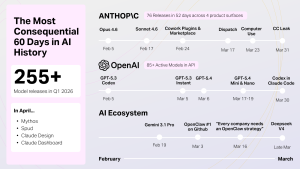
The capability adoption gap
This is the 95% paradox. AI capability is moving quickly, but adoption is not the same as execution. Many businesses are running pilots, launching tools and announcing experiments, yet very few are changing how work gets done at scale.
The issue is not ambition. It is operating design.
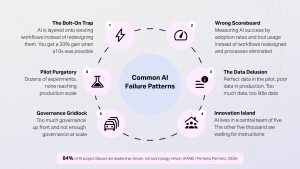
Most AI initiatives stall because they are added to the existing organization rather than used to redesign it. AI gets layered onto old workflows, old decision rights and old planning cycles. The result is a 20% gain where a 10x improvement may have been possible.
This is the bolt-on trap.
Why AI initiatives stall
Organizations also fall into pilot purgatory, where dozens of experiments never reach production. They create innovation islands, where a small central AI team moves quickly while the rest of the business waits. They measure the wrong things, tracking adoption rates and tool usage rather than workflows redesigned or processes eliminated.
They build pilots on perfect data, then find production data is too messy, too limited or too fragmented. They add heavy governance early, but lack the governance needed to scale safely.
The common thread is leadership. Research cited in Pertama Partners shows that 84% of AI project failures are driven by leadership, not technology.
That should change the conversation.
Leaders must redesign the factory
If AI failure is leadership-driven, then AI execution cannot sit only with technology teams. It must sit with the leaders who own performance, operating models and accountability.
Productive individuals do not automatically create productive firms. A person using AI may move faster, but if the workflow around them stays the same, the organization simply creates new bottlenecks.
This is why leaders must redesign the factory.
The factory is the way work is structured, governed, measured and improved. It includes the workflows people follow, the decisions they make, the data they use, the handoffs they tolerate and the planning rhythms that shape what gets funded.
If that factory was built for a world where human effort was the constraint, it will not capture the full value of AI.
Four shifts to make this quarter
Real execution requires the following four shifts.
- AI has to move from a project to an operating principle. It cannot be treated as a side initiative, owned by a small team and measured by activity. It has to shape how the organization chooses priorities, redesigns work and creates value.
- The model of work has to change from humans doing work with AI help, to AI doing work with human oversight. That does not remove human judgment. It changes where judgment is applied. Leaders need to decide which work should be automated, which work should be supervised and where people create the most value.
- Organizations need to stop simply improving processes and start eliminating them. If AI is used only to speed up existing steps, the business keeps the same complexity at a faster pace. The greater value comes from asking which steps no longer need to exist.
- Annual planning cycles need to give way to continuous adaptation. AI capability is changing too quickly for static plans. In 12 months, AI may be 10x more capable. The organization needs a way to keep learning, redesigning and scaling as the technology changes.
The execution question
This is the real secret to AI execution. It is not more pilots. It is not more tools. It is not waiting for perfect data or perfect clarity.
It is building an operating system for AI transformation: one that gives leaders the ability to prioritize the right work, redesign workflows, govern at scale and measure what actually changed.
The organizations creating competitive advantage aren’t the ones with the most experiments. They are the ones turning AI into an execution engine inside the enterprise.
In 12 months, AI will be 10x more capable.
The leadership question is simple: what will it take for your organization to be too?

You may also like

Articles
When your client becomes an agent

Articles
Why faster isn’t always better with AI

Articles
Maximizing the return on AI: Lessons from Google’s advertising platform

Articles
August 2026 AI Insights

Articles
The barrier isn’t out there. It’s in here.

Articles
When your Agents start talking: The accountability challenge of Agentic AI

Articles
Scaling value propositions: AI only works when the operating system comes first

Articles
AI won’t transform your commercial performance. Your processes will.

Articles
Stop ‘just’ adopting AI

Articles

