

Articles
ERP in the age of AI: The continuous reinvention engine

For most of its history, ERP has been defined by its end: go live. Programs were long, complex and exhausting, but they had a clear destination. Once the system switched on, the organization exhaled. The project team disbanded. The consultants rolled off. The system entered ‘BAU,’ a term that quietly signaled that ambition was over.
But the AI era has upended that pattern. Today, the real value of ERP increasingly arrives after go-live. AI-driven optimization, automation and insight do not peak on day one; they accelerate over time. Releases and capabilities change monthly. Now it is possible for the system to evolve faster than most organizations’ ability to absorb it.
ERP is shifting from a system you implement to a system you continually reinvent. In this new world, go-live is no longer the final milestone. It is the starting line.
That shift carries profound implications. If ERP’s value now comes from continuous reinvention rather than one-off delivery, then the program itself cannot behave like a temporary initiative. It must lay the foundations for a future operating model in which ERP continually adapts – and the organization adapts with it. This is the missing realization for many leaders: the conditions for success after go-live are created during the program, or they are not created at all. And unless leaders redesign how ERP is governed, staffed and led beyond go-live, they will unlock only a fraction of the value AI makes possible.
The new starting line and what the program must now deliver
Once you accept that ERP keeps evolving well after the program, a second truth becomes unavoidable: the program’s purpose expands. It cannot simply implement software or deliver scope. It must prepare the organization for a world where ERP changes continuously – often faster than governance, culture and behaviors can keep up. This preparation has two components, both of which are now essential.
The first is AI governance: the rules, guardrails and structures that determine how AI is used, managed and scaled within the ERP estate. The second is cultural readiness: the mindsets and behaviors required from leaders and users to operate confidently in a system that evolves month by month.
These two elements are inseparable. AI will accelerate change, but only strong governance will channel that acceleration productively. Continuous updates will create opportunity, but only a cultural shift toward curiosity and adaptability will allow those opportunities to be realized.
And critically, both must be built during the program – not attempted retrospectively, once the system is live. By then, the window has closed.
Why AI governance has become the program’s most important team
On modern ERP programs, AI arrives early and aggressively. Automated test creation, code remediation engines, blueprint-to-config generators and AI documentation tools quickly become part of the daily workflow. Timelines compress. Productivity jumps. This is the new delivery baseline.
Yet amid this flurry of AI tooling, something critical is often missing: a dedicated capability to govern it.
AI tooling doesn’t behave like traditional software. It learns, adapts and evolves. It produces outputs that need validation and oversight. It can introduce new risks as quickly as it creates value. And unlike previous waves of automation like RPA, workflow tools, macros etc., AI doesn’t sit neatly inside a single workstream. It cuts across all of them.
This is why modern ERP programs now require a function that simply didn’t exist before: an AI governance layer embedded within the PMO/TMO, responsible for:
- Defining how AI is used
- Ensuring compliance, safety and ethical standards
- Establishing design principles, patterns and guardrails
- Managing risk, bias, security and IP exposure
- Orchestrating adoption to prevent fragmentation
- Measuring the impact of AI on cost, quality and speed
The biggest risk on AI-enabled ERP programs is not tool immaturity – it is unmanaged enthusiasm. Uncoordinated AI usage across numerous teams quickly produces inconsistencies in documentation, unpredictable decisions, duplicate work and rising operational risk. The program must therefore treat AI as a capability that needs strategy, not just tools; governance, not just pilots; and intentional design, not opportunistic usage.
This is the foundation on which continuous reinvention rests. Without AI governance during the program, there is no continuity after it.
Preparing people for a continually changing ERP
The second foundation the program must build is cultural. ERP has always been associated with stability. The system was implemented, trained, embedded and then left alone. Many employees spent their entire careers working with a stable ERP landscape. Change was unusual; major change was generational.
AI breaks that expectation completely. Vendor releases now arrive quarterly. AI co-pilots evolve monthly. Process optimizations surface continuously. The idea of a “steady-state ERP” is now incompatible with reality.
Most organizations are not ready for this. Employees expect ERP to be predictable. Leaders expect long horizons before change. Governance forums expect few decisions between major phases. Everything about the traditional ERP operating model assumes stasis.
This is why the ERP program itself plays a new role. It can no longer stop at building the platform. It must equip the organization for continuous change. The program must become the catalyst for a new mindset, one that embraces iteration, experimentation and curiosity.
The program must help the organization build new muscles: curiosity, adaptability, experimentation and comfort with frequent iteration. These behaviors cannot be taught after go-live; they must be nurtured during the program, while leaders are engaged, teams are mobilized and attention is high.
Just as importantly, the structures created during delivery – the AI governance layer, the transformation office, the cross-functional leadership forums – must not be disbanded. They must transition directly into business-as-usual. Without them, organizations lose the very capabilities required to stay aligned with the technology they just invested in.
This is not a soft-skills exercise; it is an operational necessity. If the organization does not adapt culturally, it will not be able to adapt technically.
ERP meets continuous change, and the old operating model breaks
When these two foundations – AI governance and cultural readiness – are not established during the program, organizations face a predictable pattern after go-live: the system evolves, but the organization does not. Releases stack up, AI capabilities remain unused, enhancements slow and value decays.
What emerges is a new kind of technical debt, not from customization, but from missed opportunity.
Continuous change is now the defining characteristic of ERP. Governing it requires structures that stay in place. Adopting it requires a workforce that is ready for perpetual learning. Without those conditions, ERP quickly reverts to a static system inside a dynamic world, an outcome that defeats the entire purpose of modernization.
The new post go-live operating model
When go-live arrives, the real operating model begins. The expert teams built for the program – see my previous article on the new delivery pyramid – form the nucleus of a new, permanent construct: small, cross-functional reinvention squads.
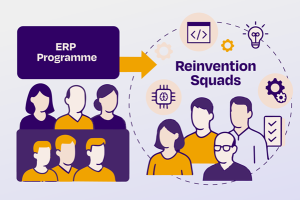
These squads do not exist to ‘support’ the system. They exist to improve it. They work in quarterly cycles, aligned to vendor releases, continuously delivering enhancements that use AI to improve efficiency, decision-making and resilience. They are supported by AI-driven testing, blueprint-to-config generators, documentation co-pilots and other accelerators that make frequent change sustainable.
System integrators still play a role, but a more precise one. Instead of dominating the transformation, they become modular capacity, experts brought in for targeted work under the direction of the client’s own transformation office and AI governance structures. In this world, ERP behaves like a product: with a roadmap, a backlog, a release cadence and a funding model that recognizes its ongoing evolution.
Over time, the operating rhythm becomes familiar. Process owners identify opportunities, often surfaced by AI simulations or analytics. Reinvention squads build and test enhancements, with AI automating much of the regression work. Releases go out quarterly, with adoption co-pilots guiding users through new capabilities. Resistance is monitored in real time. Benefits are tracked by an ERP value office that reports to the executive team.

What this means for clients
This new model of ERP fundamentally reshapes what clients must build and how they must lead.
The first major shift is structural. ERP can no longer be treated as a temporary program that mobilizes intensely and then disappears. Because value now emerges over time, often long after go-live, organizations need a standing team to steward the platform. This team is smaller, more expert and more cross-functional than traditional ERP organizations, but it is permanent. ERP is now a product, and products require product teams. Programs end; products endure.
A second shift concerns investment philosophy. For decades, ERP was funded like infrastructure: a large capital project followed by years of depreciation. That logic made sense when change was infrequent and upgrades were generational. But AI-native ERP evolves continuously. Improvements arrive in monthly increments, not decade-long cycles. Value accumulates gradually. The funding model must reflect this. Instead of a single upfront investment, organizations need an OpEx-led model that supports ongoing enhancement, experimentation and optimization. Leaders must think about ERP the way they think about any other strategic capability that demands constant refinement.
The third shift is one of ownership. ERP can no longer sit solely within IT, nor be framed as a compliance requirement to ‘keep the lights on.’ As AI drives more decision-making, insight and automation into core processes, ERP becomes a lever that influences margins, resilience and competitiveness. Prioritization therefore becomes a joint responsibility between business and technology, with governance elevated to the highest levels of the organization. ERP becomes a strategic capability reviewed at the board, not a back-office application. When ERP is treated as infrastructure, the business tolerates inefficiency; when it is treated as competitive advantage, it expects performance.
What this means for SIs
System integrators still have a role in this new landscape, but the nature of that role changes significantly. The traditional model of large, long-running teams driving the program end to end begins to lose relevance. Automation reduces the need for scale. AI tools compress design, testing and build effort. Clients expect leaner, more specialized teams that complement their own capabilities rather than overshadow them. In this world, SIs succeed not by supplying volume, but by supplying precision.
This shift also transforms how success is measured. Clients increasingly look for outcome-based delivery, where partners are rewarded for business results rather than hours billed. They want visibility into productivity, transparency around the use of AI accelerators, and clear evidence that the integrator is contributing to sustained velocity after go-live. Contracts that once revolved around timelines and scope now revolve around adoption, value realization and ongoing improvement.
The familiar distinction between SI and AMS begins to erode as well. When ERP operates in continuous cycles, the break between ‘implementation’ and ‘support’ becomes artificial. The integrators that thrive will be those who build long-term value partnerships – relationships grounded in continuous enhancement rather than episodic transformation. They will provide modular capacity: specialist teams brought in to solve specific problems quickly and effectively. The SIs who cling to monolithic programs, large teams and decade-long roadmaps will simply be too slow and too expensive for the pace of AI-enabled ERP.
In the end, the power dynamic shifts back toward the client. With AI raising productivity and reducing dependency on brute-force manpower, clients can govern ERP more directly, own more of the capability internally, and bring in partner support where it adds clear value. This creates a healthier, more transparent relationship – one grounded in outcomes, expertise and shared stewardship of a continuously evolving ERP landscape.
What this means for business leaders
None of this is ultimately about technology. It is about leadership.
Leaders must embrace faster decision cycles, recognizing that change is no longer exceptional. They must evaluate ERP as a strategic capability, not a capital project. They must champion curiosity, challenge-based thinking and AI literacy across their teams with a willingness to invest continuously, not periodically.
Equally, employees must develop new competencies. Deep system expertise becomes less important than the ability to guide, interrogate and collaborate with AI. Curiosity becomes more valuable than certainty. Adaptability becomes the defining skill of the ERP workforce.
Culture becomes the differentiator. Organizations that reward learning and experimentation will thrive. Those that cling to stability will struggle.
Conclusion: Go-live marks the beginning, not the end
AI has transformed ERP from a large-scale implementation into a continuously evolving capability. The systems can learn, adapt and improve … but only if the organization can too.
That adaptation must begin during the program. It is the program that must create the conditions for success: AI governance to ensure change is safe, coordinated and scalable; cultural and mindset shifts to ensure change is welcomed, not feared.
ERP once ended at go-live. Now it begins there – and the organizations that thrive will be those that prepare not just the system for continuous reinvention, but also themselves.